
Plats
33° 55' 28.5456" S, 18° 25' 15.8448" E
SE
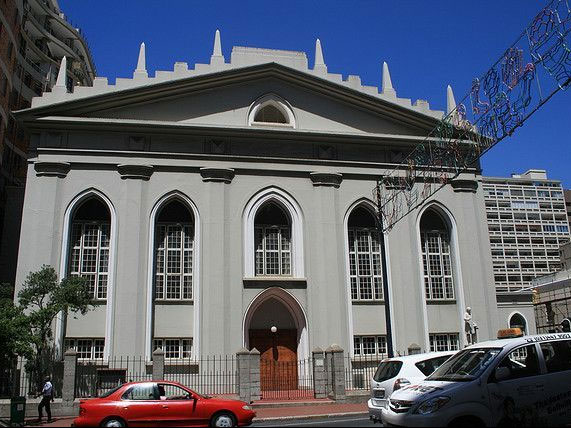
While you are in Cape Town don’t miss the opportunity to visit the Groote Kerk – or Great Church on Adderley Street.
Usually, when settlers arrive in any area, one of the first things they do is to build a church or some other gathering place of worship, but when Jan Van Riebeeck arrived in the Cape region in 1652, a church was only established three years later. Riebeeck and his men were sent to the Cape of Good Hope by the Dutch East India Company to set up a supply station for ships sailing to East Africa, India and the Far East. He was the founder of Cape Town which grew to be the most important city in South Africa at the time.
However, few ministers fancied settling in such a far-flung outpost and the population had to make do with a lay preacher to comfort them. In 1665 a minister was appointed and the Groote Kerk was founded, making it the oldest church in the region. The church was simple, as all Dutch Reformed churches are, and a bell tower was added as late as 1704. It is somewhat ironic that this addition, deemed superfluous at the time, is the only part of the original church to have survived.
The church you will see today was built by Herman Schuette in 1841. The style is a combination of Greek and Gothic; the interior is plain with a lot of heavy dark wood used for the pews and the galleries. It is not without beauty, however, and the beautifully ornate pulpit, carved out of teak by Anton Anreith and Jan Graaf, is a true masterpiece. The organ is immense and boasts 5917 pipes.
If you are interested in architecture and history but don’t want to visit museums, then you will be happy just to photograph De Tuynhuys from the outside, as it houses the offices of the State President and is not open to the public. It is rather hard to imagine, but in 1675 this building was a rather shabby tool-shed, owned by the Dutch East India Company. At the time there were few splendid buildings in the Cape Town area, which was a basic supply station for Dutch ships passing through the Cape of Good Hope on their way to the Far East and India.
In 1679, when the state governor decided to visit the growing outpost, there was a bit of a panic about where to lodge him. As the tool shed was the only unoccupied building, it was hastily enlarged into a two-storey house with a flat roof and a large veranda. By 1751 it had become the summer residence for succeeding governors and had been refurbished in the Neo-classical style with sculptures of Mercury and Poseidon added – the former being the Roman god of trade and the latter the god of the sea – to enhance Dutch prowess at both trade and sailing. The beautiful front door was created by a slave carpenter, Rangton Van Bali, whose excellent work later earned him his freedom.
In 1824 a lovely ballroom was added, but the building was damp and no longer habitable except during the driest months of the year. At the beginning of the 20th century the town council considered demolishing it, but as the house was linked to the city’s history, they couldn’t decide whether to knock it down or not.
Usually, when settlers arrive in any area, one of the first things they do is to build a church or some other gathering place of worship, but when Jan Van Riebeeck arrived in the Cape region in 1652, a church was only established three years later. Riebeeck and his men were sent to the Cape of Good Hope by the Dutch East India Company to set up a supply station for ships sailing to East Africa, India and the Far East. He was the founder of Cape Town which grew to be the most important city in South Africa at the time.
However, few ministers fancied settling in such a far-flung outpost and the population had to make do with a lay preacher to comfort them. In 1665 a minister was appointed and the Groote Kerk was founded, making it the oldest church in the region. The church was simple, as all Dutch Reformed churches are, and a bell tower was added as late as 1704. It is somewhat ironic that this addition, deemed superfluous at the time, is the only part of the original church to have survived.
The church you will see today was built by Herman Schuette in 1841. The style is a combination of Greek and Gothic; the interior is plain with a lot of heavy dark wood used for the pews and the galleries. It is not without beauty, however, and the beautifully ornate pulpit, carved out of teak by Anton Anreith and Jan Graaf, is a true masterpiece. The organ is immense and boasts 5917 pipes.
If you are interested in architecture and history but don’t want to visit museums, then you will be happy just to photograph De Tuynhuys from the outside, as it houses the offices of the State President and is not open to the public. It is rather hard to imagine, but in 1675 this building was a rather shabby tool-shed, owned by the Dutch East India Company. At the time there were few splendid buildings in the Cape Town area, which was a basic supply station for Dutch ships passing through the Cape of Good Hope on their way to the Far East and India.
In 1679, when the state governor decided to visit the growing outpost, there was a bit of a panic about where to lodge him. As the tool shed was the only unoccupied building, it was hastily enlarged into a two-storey house with a flat roof and a large veranda. By 1751 it had become the summer residence for succeeding governors and had been refurbished in the Neo-classical style with sculptures of Mercury and Poseidon added – the former being the Roman god of trade and the latter the god of the sea – to enhance Dutch prowess at both trade and sailing. The beautiful front door was created by a slave carpenter, Rangton Van Bali, whose excellent work later earned him his freedom.
In 1824 a lovely ballroom was added, but the building was damp and no longer habitable except during the driest months of the year. At the beginning of the 20th century the town council considered demolishing it, but as the house was linked to the city’s history, they couldn’t decide whether to knock it down or not.
Taggar:
Rekommenderade besökstider:
1
Bilder: